
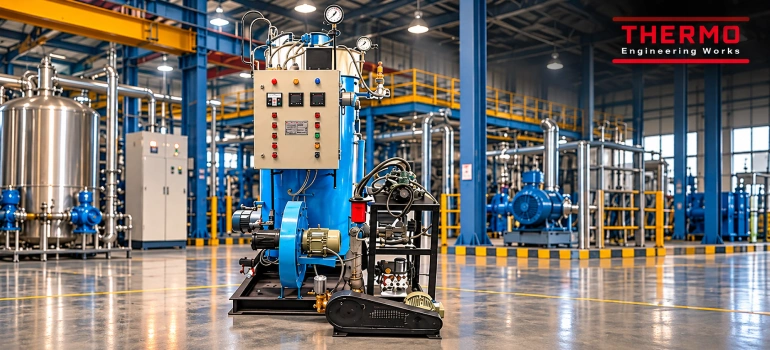
What Are the Applications of Non-IBR Steam Boilers in Textile and Chemical Industries?
Steam plays an important role in industrial manufacturing because it provides the heat required for different production processes. Industries such as textiles and chemicals depend on a consistent steam supply to maintain production quality, improve operational efficiency, and support temperature-sensitive applications. Among the different industrial heating solutions available, Non-IBR steam boilers are widely considered for applications that require low-pressure steam generation and suitable heating capacities.
Non-IBR steam boilers are steam-generating systems that fall outside the scope of boilers regulated under the Indian Boilers Regulations (IBR), subject to applicable technical and legal conditions. These boilers are generally considered for specific industrial applications where the operating pressure, heating surface, and other design parameters meet the relevant regulatory exemptions.
In textile manufacturing, Non-IBR steam boilers support processes such as fabric dyeing, washing, drying, and finishing. Similarly, chemical industries use steam for heating raw materials, maintaining process temperatures, cleaning equipment, and supporting various manufacturing operations.
Thermo Engineering Works provides industrial boiler solutions designed to meet different operational heating requirements. Understanding the applications of Non-IBR steam boilers can help manufacturers select an appropriate steam generation system for their production facilities.
What Is a Non-IBR Steam Boiler?
A Non-IBR steam boiler is a boiler that does not fall within the applicable registration and inspection requirements of the Indian Boilers Regulations because it satisfies the prescribed exemption criteria.
These boilers are generally considered for industrial operations that require steam at relatively lower pressures and within specific design limits. However, Non-IBR classification does not mean that the equipment is free from all safety, quality, or statutory requirements. Applicable factory, electrical, fire, pressure equipment, and workplace safety regulations must still be followed.
Non-IBR boilers can be suitable for smaller and medium-scale industrial applications where steam demand is moderate and operating conditions are compatible with the boiler's rated capacity.
Key Features of Non-IBR Steam Boilers
- Industrial Heating: Designed to generate steam for different industrial heating applications.
- Compact Construction: Depending on the model, these boilers can be installed in facilities with limited boiler-room space.
- Operational Flexibility: Suitable for selected low-pressure steam applications.
- Process Compatibility: Can support different manufacturing processes that require controlled heat.
- Installation Convenience: Certain models may require comparatively simpler installation arrangements.
- Energy Utilisation: Properly selected and maintained systems can support efficient fuel consumption.
- Maintenance Requirements: Routine inspection, water treatment, cleaning, and preventive maintenance help maintain performance.
Why Are Non-IBR Steam Boilers Used in Textile Industries?
The textile industry involves several manufacturing stages that require controlled heating and steam applications. From processing raw fabric to producing finished garments and textiles, steam supports different production activities.
Non-IBR steam boilers can be considered for textile manufacturing facilities that require steam within the applicable pressure and capacity limits.
1. Fabric Dyeing and Colour Processing
Dyeing is one of the major applications of steam in textile manufacturing. Different fabrics require specific temperature conditions to absorb dyes effectively and achieve consistent colour results.
Steam generated by Non-IBR boilers can be used to heat dyeing machines and processing vessels.
Applications include:
- Heating dyeing machines and dye baths.
- Maintaining required temperatures during colour processing.
- Supporting fabric dye absorption.
- Providing heat for different textile dyeing operations.
- Maintaining process consistency across production batches.
Consistent heating helps textile manufacturers achieve better colour uniformity and reduce processing variations.
2. Fabric Washing and Bleaching
Fabric washing and bleaching are essential processes used to remove impurities, excess dyes, oils, and other unwanted substances from textile materials.
Steam can provide the heat required for washing equipment and bleaching operations.
Common applications include:
- Heating industrial washing machines.
- Supporting hot-water preparation.
- Maintaining process temperatures during bleaching.
- Heating washing tanks and processing vessels.
- Supporting fabric preparation before further treatment.
Suitable steam generation helps textile facilities maintain consistent washing conditions.
3. Textile Drying Applications
After washing, dyeing, and other wet-processing operations, fabrics contain moisture that must be removed before further processing.
Steam can be used as a heating medium in textile drying equipment, including steam-heated dryers and drying chambers.
Important applications include:
- Heating fabric drying machines.
- Supporting continuous textile drying operations.
- Maintaining suitable drying temperatures.
- Reducing moisture content before finishing.
- Supporting consistent fabric processing.
The required steam supply depends on the fabric type, moisture level, drying equipment, and production capacity.
4. Fabric Finishing and Processing
Fabric finishing improves the appearance, texture, performance, and usability of textile materials. Different finishing treatments require controlled temperature conditions.
Non-IBR steam boilers can support steam-based heating systems used in finishing operations.
Applications include:
- Heating textile finishing machines.
- Supporting fabric conditioning processes.
- Providing heat for finishing chemical preparation.
- Maintaining temperature conditions during processing.
- Supporting selected steam-based fabric treatment operations.
Proper temperature management helps manufacturers maintain the desired fabric characteristics.
5. Textile Printing Operations
Textile printing involves applying designs, patterns, and colours to fabrics using specialised printing techniques.
Certain printing methods require steam for colour fixation and treatment. Steam can also support heating requirements in associated equipment.
Applications include:
- Supporting steaming equipment.
- Providing heat for selected printing processes.
- Supporting colour fixation operations.
- Maintaining controlled processing temperatures.
- Heating auxiliary production equipment.
The steam pressure and temperature must match the specific requirements of the printing process.
6. Heating Water for Textile Production
Textile manufacturing facilities require hot water for washing, dyeing, cleaning, and other production activities.
Steam boilers can supply heat through heat exchangers, allowing manufacturers to prepare hot water for different industrial requirements.
Benefits include:
- Consistent hot-water availability.
- Support for multiple production sections.
- Better temperature control.
- Reduced dependence on separate water-heating systems.
- Improved coordination of heating operations.
What Are the Applications of Non-IBR Steam Boilers in Chemical Industries?
Chemical manufacturing involves several processes that require controlled heating, temperature maintenance, and thermal energy. Steam is commonly used because it transfers heat effectively and can be distributed through insulated pipelines to different production sections.
Non-IBR steam boilers can support selected chemical manufacturing operations when the required pressure, temperature, and steam capacity are within their design and regulatory limits.
1. Heating Chemical Reactors
Chemical reactors are used to carry out reactions between different raw materials. Many chemical reactions require specific temperature conditions to achieve the desired product quality.
Steam can be supplied to reactor jackets or suitable heat exchangers to provide indirect heating.
Applications include:
- Heating reactor vessels.
- Maintaining required reaction temperatures.
- Supporting controlled batch processing.
- Providing thermal energy for selected chemical reactions.
- Heating raw materials before processing.
Proper temperature control helps maintain consistent manufacturing conditions and product quality.
2. Raw Material Heating
Several chemical raw materials need to be heated before they can be mixed, transferred, or processed.
Steam-based heating systems can support the preparation of raw materials before they enter production equipment.
Common applications include:
- Heating liquid chemical ingredients.
- Reducing the viscosity of selected materials.
- Heating storage tanks through suitable coils or jackets.
- Supporting raw material preparation.
- Maintaining temperatures during material transfer.
The heating arrangement should be selected according to the chemical properties and compatibility of the materials being processed.
3. Chemical Mixing and Blending
Chemical mixing and blending involve combining different ingredients to achieve the required formulation. Certain materials need controlled heating to improve mixing and processing characteristics.
Steam can provide indirect heat to mixing tanks and blending equipment.
Applications include:
- Heating mixing vessels.
- Supporting temperature-sensitive blending operations.
- Maintaining material consistency.
- Heating selected industrial formulations.
- Supporting batch preparation activities.
Steam heating can help maintain suitable operating temperatures without direct contact between steam and the chemical product when an indirect heating arrangement is used.
4. Cleaning and Equipment Washing
Chemical manufacturing plants require regular cleaning of tanks, pipelines, processing vessels, and production equipment.
Steam can support cleaning operations and hot-water generation, depending on the equipment and cleaning procedure.
Applications include:
- Heating cleaning water.
- Supporting industrial equipment washing.
- Heating cleaning-in-place (CIP) systems where suitable.
- Supporting maintenance and sanitation operations.
- Providing heat for selected cleaning processes.
The cleaning method must be compatible with the equipment materials and chemicals used in the facility.
5. Heating Storage Tanks and Pipelines
Some chemicals become more viscous or difficult to transfer when temperatures decrease. Maintaining suitable temperatures can help improve material handling.
Steam can be circulated through tank jackets, heating coils, or compatible pipeline tracing arrangements.
Applications include:
- Maintaining suitable storage temperatures.
- Supporting the transfer of temperature-sensitive liquids.
- Heating selected chemical storage tanks.
- Reducing viscosity where temperature control is appropriate.
- Supporting smooth material movement through pipelines.
The required temperature must be determined based on the chemical's properties and safety data.
6. Solvent and Chemical Processing
Certain chemical processing operations require thermal energy for heating, conditioning, or maintaining controlled operating temperatures.
Steam may be used indirectly through heat exchangers or jackets in compatible systems.
Applications include:
- Heating selected processing vessels.
- Supporting raw material conditioning.
- Maintaining process temperatures.
- Providing heat for auxiliary chemical manufacturing operations.
- Supporting controlled batch production.
For solvent-related applications, the boiler and heating system must be selected with careful consideration of flammability, process hazards, ventilation, and temperature limitations.
7. Industrial Hot Water Generation
Chemical plants require hot water for different manufacturing and utility operations.
Steam boilers can transfer heat to water through heat exchangers, providing a suitable hot-water supply for industrial applications.
This arrangement can support:
- Equipment cleaning.
- Raw material preparation.
- Process vessel washing.
- General plant maintenance.
- Auxiliary heating requirements.
How Do Non-IBR Steam Boilers Benefit Textile and Chemical Industries?
Selecting an appropriate boiler can influence production efficiency, operating costs, maintenance requirements, and overall plant performance.
Non-IBR steam boilers may offer several operational advantages when selected according to the application's requirements.
Major Benefits
1. Suitable for Specific Low-Pressure Applications
Non-IBR boilers can be considered for industrial processes that require steam within applicable low-pressure operating limits.
2. Compact Installation Options
Depending on the boiler design and capacity, certain models can be installed in comparatively smaller industrial spaces.
3. Support for Multiple Applications
A suitably designed steam distribution system can supply heat to different compatible production sections.
4. Operational Flexibility
These boilers can support batch-based and continuous operations when their steam-generation capacity matches the production demand.
5. Controlled Heating
Steam provides a convenient method of transferring heat to vessels, tanks, dryers, and processing equipment.
6. Potential Energy Savings
Appropriate boiler sizing, insulation, condensate recovery, efficient combustion, and regular maintenance can help reduce unnecessary energy consumption.
7. Simplified Maintenance Planning
A well-designed maintenance schedule can help identify performance issues early and reduce unexpected production interruptions.
How to Choose the Right Non-IBR Steam Boiler for Industrial Applications?
Choosing the correct boiler requires an understanding of production requirements, steam consumption, operating conditions, and safety considerations.
Manufacturers should evaluate the following factors before making a purchasing decision.
1. Required Steam Generation Capacity
Calculate the total steam demand of the production equipment. Consider both normal operating consumption and peak steam requirements.
2. Operating Pressure and Temperature
Identify the pressure and temperature needed by the textile or chemical manufacturing process. Ensure that the boiler is suitable for these operating conditions.
3. Fuel Availability
Evaluate available fuel options based on cost, accessibility, efficiency, and environmental requirements.
4. Boiler Room Space
Check the available installation area, ventilation, access for maintenance, and necessary safety clearances.
5. Water Quality
Boiler feedwater quality directly affects performance and equipment life. Appropriate water treatment helps control scaling, corrosion, and deposits.
6. Safety and Regulatory Compliance
Verify the applicable boiler classification, statutory requirements, safety devices, inspection obligations, and installation conditions.
7. Maintenance and After-Sales Support
Choose a manufacturer or supplier that can provide technical guidance, maintenance support, and information about operating procedures.
What Safety Measures Should Industries Follow When Using Non-IBR Steam Boilers?
Although qualifying Non-IBR boilers may be exempt from certain IBR requirements, industrial safety remains essential.
Textile and chemical facilities should implement appropriate safety measures to protect employees and equipment.
Recommended safety practices include:
- Install suitable pressure gauges and safety valves.
- Monitor boiler operating pressure and temperature.
- Maintain appropriate water levels.
- Use suitable feedwater treatment systems.
- Inspect steam pipelines and connections regularly.
- Check insulation for damage and heat loss.
- Train operators in safe boiler operation.
- Follow manufacturer-recommended maintenance schedules.
- Maintain proper ventilation in the boiler room.
- Keep emergency shutdown procedures accessible.
- Conduct inspections according to applicable laws and safety standards.
Chemical industries should also evaluate process-specific risks, including hazardous substances, flammable materials, and the possibility of chemical exposure.
Why Choose Thermo Engineering Works for Industrial Boiler Solutions?
Selecting an appropriate industrial boiler is an important decision for manufacturing businesses. The right equipment should meet the required steam demand, support production operations, and comply with applicable technical and regulatory requirements.
Thermo Engineering Works focuses on industrial boiler solutions for businesses looking for suitable steam-generation systems for their operational needs.
When evaluating boiler solutions, manufacturers should consider:
- Application-Based Selection: Identifying boiler solutions according to textile, chemical, and other industrial heating requirements.
- Capacity Consideration: Matching steam-generation capacity with production demand.
- Technical Guidance: Understanding operating pressure, steam consumption, and installation requirements.
- Operational Efficiency: Considering fuel utilisation, insulation, condensate recovery, and system design.
- Safety Considerations: Prioritising suitable safety devices and applicable regulatory compliance.
- Maintenance Support: Planning preventive maintenance to support reliable equipment performance.
Businesses looking for Non-IBR steam boiler solutions should discuss their process requirements with Thermo Engineering Works to identify a suitable system.
Frequently Asked Questions (FAQs)
1. What is a Non-IBR steam boiler?
A Non-IBR steam boiler is a boiler that qualifies for exemption from the applicable Indian Boilers Regulations based on prescribed technical conditions. It is generally considered for specific low-pressure industrial steam applications.
2. What are the main applications of Non-IBR steam boilers in textile industries?
Non-IBR steam boilers can support fabric dyeing, washing, bleaching, drying, finishing, printing-related steaming, and industrial hot-water generation, depending on the required operating conditions.
3. Can Non-IBR steam boilers be used in chemical industries?
Yes. They can be used for suitable applications such as reactor heating, raw material preparation, chemical mixing, tank heating, equipment cleaning, and other compatible industrial processes.
4. Are Non-IBR boilers suitable for low-pressure steam applications?
They can be suitable for qualifying low-pressure applications. The actual suitability depends on the boiler's design, rated operating conditions, process requirements, and applicable regulatory exemptions.
5. What is the difference between IBR and Non-IBR boilers?
IBR boilers fall under the applicable Indian Boilers Regulations, while qualifying Non-IBR boilers are exempt from specified IBR requirements. Their classification depends on technical and statutory conditions rather than simply their intended application.
6. Do Non-IBR steam boilers require regular maintenance?
Yes. Regular maintenance is important for safe and reliable operation. It includes checking safety devices, monitoring water quality, cleaning boiler surfaces, inspecting pipelines, and following the manufacturer's maintenance recommendations.
7. Can one Non-IBR boiler support multiple textile production processes?
Yes, provided its steam-generation capacity, operating pressure, distribution system, and operating conditions are suitable for the combined steam demand of the connected equipment.
8. Which fuel options are available for Non-IBR steam boilers?
Fuel options depend on the boiler model and design. Depending on the manufacturer's specifications, available options may include diesel, furnace oil, gas, or solid fuels. Fuel compatibility and emissions requirements should be verified before selection.
9. How can industries improve Non-IBR steam boiler efficiency?
Industries can improve efficiency through proper boiler sizing, regular maintenance, effective insulation, suitable water treatment, combustion optimisation, condensate recovery, and monitoring of steam consumption.
10. How do I select the right Non-IBR steam boiler for my factory?
Evaluate your steam consumption, operating pressure, required temperature, fuel availability, installation space, water quality, and regulatory requirements. Consult an experienced boiler manufacturer to identify a suitable configuration.